WORDS BYJennifer Nandi
PHOTOGRAPHY BYRamya Reddy
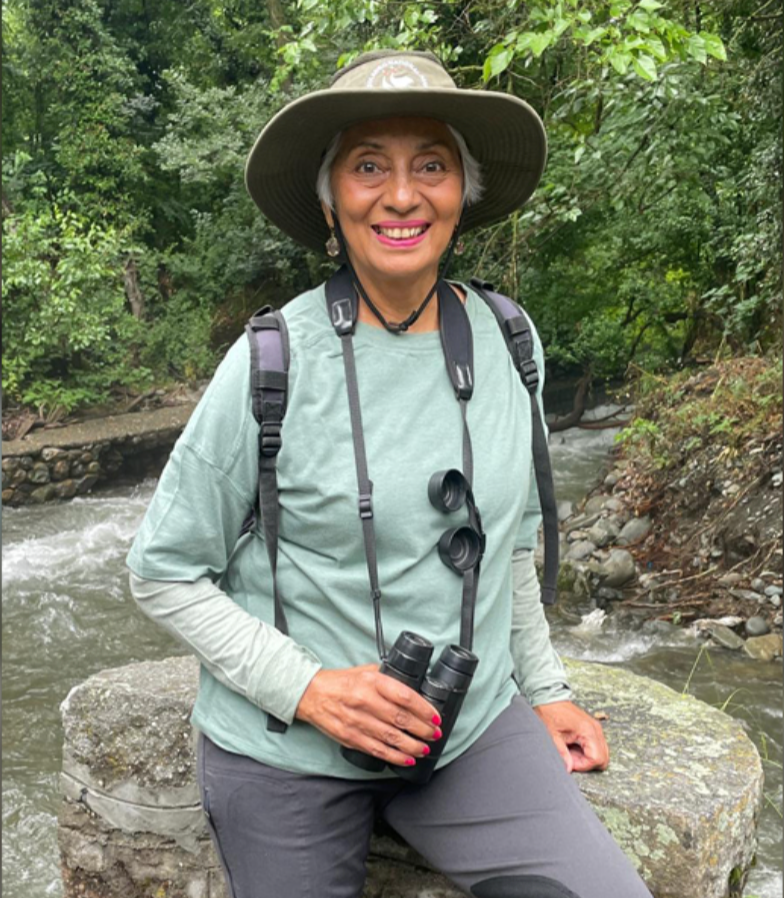
Over forty years ago, back when my idealism was still shiny and new, I began volunteering—first in Goa and later in Dehradun—to persuade people to live more gently on the Earth—to change their environmental habits so that they become more ecologically sensitive. I thought I was teaching them to recycle, to plant trees, to treat rivers with reverence… but somewhere along the way, I struggled with the question—what am I really asking them to do? Over time, came the startling answer—I was asking them to redefine “home.”

When I return from a trek, nothing feels better than collapsing into my sofa—a sofa so perfectly contoured to me that it knows the exact shape of my backside. That cosy sense of home, surrounded by familiar things, comforts and restores me. But over the years, I realized that this wasn’t enough. I needed to seek out “home” in wilder, broader, and more imaginative ways. I stretched my concept of home to include wherever I was. For me, home stopped being defined by walls and a roof. It didn’t stop at my front door or even at my garden hedge. It extended to the bare lava rock behind my neighbour’s house in Goa, where I’d sit quietly, watching birds, every bit as content as when I was bustling about my kitchen, cooking for my children.

When my daughter was seven, we’d hike through dense forests in the Western Ghats, crossing river after river until our legs felt like overcooked noodles. That heady combination of exhilaration and comfort stayed with me, and when I began climbing mountains later in life, it deepened into something more profound—a reverence. A reverence that swept away guilt, envy, greed, or anger and replaced them with a fierce, almost sacred love for the Earth.
I began to understand something vital: love isn’t really love unless it’s accompanied by service. You can’t claim to love a person—or a planet—while simultaneously exploiting them. At home, my family relationships were built on unconditional love, partnership and reciprocity. I didn’t see my family as an endless resource to take from, nor they me. So why should my relationship with the Earth be any different? My family had its own set of values: respect for life, gratitude, balance, and—above all—reciprocity.
I began to understand something vital: love isn’t really love unless it’s accompanied by service. You can’t claim to love a person—or a planet—while simultaneously exploiting them. At home, my family relationships were built on unconditional love, partnership and reciprocity. I didn’t see my family as an endless resource to take from, nor they me. So why should my relationship with the Earth be any different? My family had its own set of values: respect for life, gratitude, balance, and—above all—reciprocity.
Recognizing this kinship means engaging in reciprocal relationships with the natural world. The health of the planet and the health of a person are intertwined; the rights of one are the rights of the other. My ecological self—my ecological ego—grew as my understanding matured, expanding beyond my immediate family to encompass this planetary family. Don’t take without giving something back is a principle my study of natural history only reinforced.
Enriched by my study of natural history, I learned that everything, not only so-called living beings but all beings, from a wildflower to a star, undergoes this pattern of living, dying, and being reborn. Each has its lifetime when they strut their stuff. They don’t just disappear, but rather resurrect in a new form. Moreover, they give off progeny—stars explode as supernovae, scattering the building blocks of life throughout galaxies, planets, and eventually, us. If that isn’t resurrection, rebirth or reincarnation, then what is?
Each of us shares the whole span of life’s time on Earth. Since the very ingredients of our bodies are traceable to ancient stars, when I look up at the night sky—not here in Delhi, where the stars have been banished by neon and smog, but on a cloudless night in the mountains, for that’s how far one must go to truly see them—I’m struck by the dizzying thought that the universe is not merely out there, but in us. We are, quite literally, stardust. I know of no greater revelation that modern science offers. As Neil deGrasse Tyson so perfectly puts it, “That makes me feel large.” And it does. It reminds me that there is far more "Self" to know than what is contained in our personal histories—more constellations in our souls than names in our family trees.
Each of us shares the whole span of life’s time on Earth. Since the very ingredients of our bodies are traceable to ancient stars, when I look up at the night sky—not here in Delhi, where the stars have been banished by neon and smog, but on a cloudless night in the mountains, for that’s how far one must go to truly see them—I’m struck by the dizzying thought that the universe is not merely out there, but in us. We are, quite literally, stardust. I know of no greater revelation that modern science offers. As Neil deGrasse Tyson so perfectly puts it, “That makes me feel large.” And it does. It reminds me that there is far more "Self" to know than what is contained in our personal histories—more constellations in our souls than names in our family trees.

In this great cosmic family, we humans are just the noisy two-legged relatives. Around us are the four-leggeds, the winged creatures, the finned ones, the creeping and crawling ones, the rock people, the tall straight ones (trees, not humans), the rolling hills, the clouds, the starry nations—all our relations.
As a child, Wordsworth’s hymns to nature enchanted me. But as an adult, I began to see that this enchantment isn’t just poetic—it’s profoundly practical. When in contact with the Earth, I feel a healthy intoxication with whatever addresses the senses. Children are born with this wonder. They don’t see themselves as separate from the natural world. Sadly, many adults lose this connection, burying it under urban psyches, deadlines, and to-do lists.
For me, nature continually brings me back to this sense of wonder. A fragile alpine flower growing against all odds on a barren rock can teach lessons in resilience, frugality, and recycling. Every fallen leaf on a forest path is a manuscript, written in decay and renewal, if only we take the time to read it. Even tiny snails chewing at that leaf are part of a grand choreography of transformation. And lying beneath the thin skin of recorded history in our land is geology– ubiquitous but concealed. This is the hidden landscape. To achieve a balanced state of mental health, I try to order my interior landscape according to that exterior landscape.

We cannot live our lives entirely isolated from the natural world– though modern life often tries to convince us otherwise. Sure, our water may gush obediently from a faucet instead of a well, and our food may arrive shrink-wrapped and bar-coded instead of tumbling in from a wheelbarrow. But peel back the packaging and the truth remains: we are increasingly dependent on clean rivers, on healthy forests, on living, breathing soil.
What we need is a shift in vision—to see with fresh eyes the beauty of the natural world, to feel its rhythms and its patient order, and to pass that wonder on to our children and our children’s children. For in the end, this planet is not just where we live. It is our first, last, and only true home.

Most people are sincerely concerned about the environment. They fret about melting glaciers and disappearing species, but the global scale of the issue is overwhelming to address and often leaves them paralysed. The household feels too small to matter; the nation feels impossibly large to influence. It’s like being asked to clean an entire street armed with nothing but a toothbrush.
The answer lies in seeing these wild spaces as home. The more we see these wild spaces as part of our home, the smaller the gap becomes between ‘nature and culture’. It’s harder to ignore a problem when it’s literally on your living-room carpet—or in this case, your local wetland.
The answer lies in seeing these wild spaces as home. The more we see these wild spaces as part of our home, the smaller the gap becomes between ‘nature and culture’. It’s harder to ignore a problem when it’s literally on your living-room carpet—or in this case, your local wetland.
When the forest is your living room, and the river your front yard, environmental destruction becomes personal. And like any good home, this one must also welcome diversity—not just of species but of ideas, cultures, and perspectives. Think of it as a potluck dinner where every guest brings their own unique dish, and if you’re lucky, nobody brings the same soggy potato salad!
Even places of worship must reckon with this reality. Perhaps it’s time for them to take a closer look at how they address the ecological crisis. Spiritual institutions are meant to guide us in how to live well, but are they helping us live well with the world? Many are still grappling with ancient texts while modern crises rage on. Are they catalysts for ecological awakening—or just idling politely while the planet overheats?
Expanding our sense of home may be the most radical act of all. Because ultimately, you wouldn’t trash your living room—or at least not if you were expecting guests. And considering we share this planetary home with eight billion roommates, perhaps it’s time we tidied up a bit.
Expanding our sense of home may be the most radical act of all. Because ultimately, you wouldn’t trash your living room—or at least not if you were expecting guests. And considering we share this planetary home with eight billion roommates, perhaps it’s time we tidied up a bit.



You may also like
Imbibe•Issue 10
Infinite Hearth
BY Nishi Chawla
Imbibe•Issue 10
Of Letter Boxes, Boxes and Forest Homes
BY K Srilata
Imbibe•Issue 10
In the Shade of My Grandfather’s Tree
BY Hoihnu Hauzel

Imbibe•Issue 9
Under the Skin of Silence
BY Krittika Sharma

Imbibe•Issue 8
Co-Becoming: The Human-Dog Kinship
BY Sindhoor Pangal
Imbibe•Issue 10
All Roads Lead to Home: Arundhathi Subramaniam on Homecoming
BY Arundhathi Subramaniam, Ashna Ashesh
Imbibe•Issue 9
How Stories Arrive: Geeta Ramanujam on Listening
BY Ramya Reddy, Rupali Goel

Imbibe•Issue 7
Roots and Resilience: A Conversation with Vanya Orr
BY Ramya Reddy