WORDS BYK Srilata
ILLUSTRATIONS BYRupali Goel
From the places you loved and had to leave: that if, like the fairytale giant, you leave your heart hidden there, sure, you become invulnerable, but you also run the risk of always having to remember - always having to return to the heart you chose to hide there. Which, in turn, will once again make you vulnerable.
(What I saw, heard, learned … by Giorgio Agamben, Trans. by Alta L. Price, Seagull, 2023)
Yet I cannot tarry longer.
(What I saw, heard, learned … by Giorgio Agamben, Trans. by Alta L. Price, Seagull, 2023)
Yet I cannot tarry longer.
The sea that calls all things unto her calls me, and I must embark.
For, to stay, though the hours burn in the night, is to freeze
and crystallize and be bound in a mould.
Fain would I take with me all that is here. But how shall I?
A voice cannot carry the tongue and the lips that gave it wings.
Alone must it seek the ether.
(“The Coming of the Ship” by Kahlil Gibran from The Prophet, Knopf, 1923)
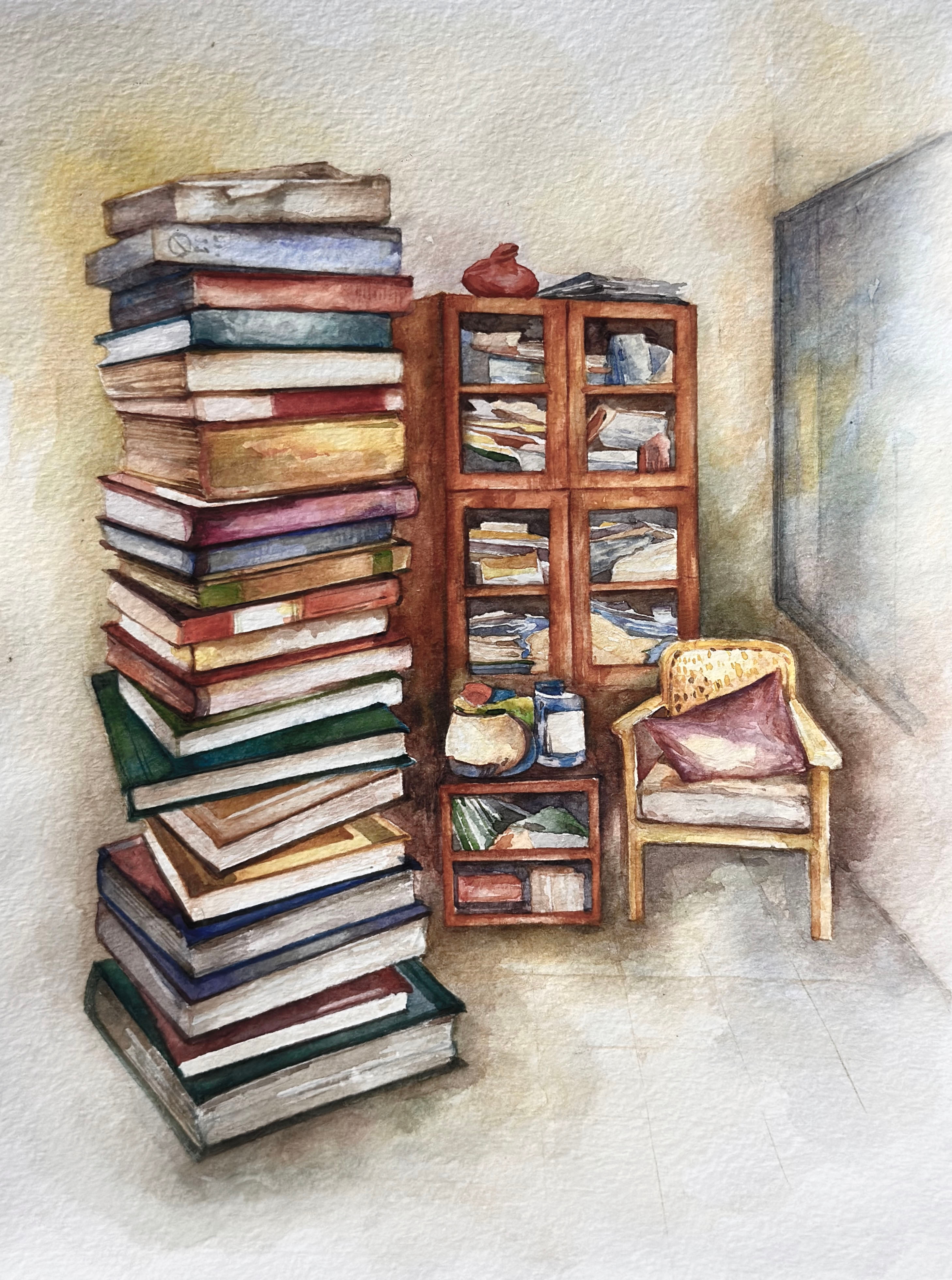
My letterbox at the place I used to call work is filling up with mail. There’s even a book parcel or two. My now former colleague calls to ask if he should collect them for me. We both know that soon, very soon, my letter box will be re-assigned, that this is a twilight moment. The university where I taught for over two decades is now a place I can never return to. I have quit of my own volition, but that doesn’t make it less of an exile.
A rock in my heart, this self-imposed, forever exile.
(“The Coming of the Ship” by Kahlil Gibran from The Prophet, Knopf, 1923)
My letterbox at the place I used to call work is filling up with mail. There’s even a book parcel or two. My now former colleague calls to ask if he should collect them for me. We both know that soon, very soon, my letter box will be re-assigned, that this is a twilight moment. The university where I taught for over two decades is now a place I can never return to. I have quit of my own volition, but that doesn’t make it less of an exile.
A rock in my heart, this self-imposed, forever exile.
They have ripped the vehicle pass off my car, and so the next time I drive in through the gates of the campus, my car will be checked. This will come to feel like a border check, a passport/visa check. It will break my heart each time. I have spent the last three months in the gut-wrenching frenzy of clearing out my office. Boxes and Boxes of books and things, each with its own little history. The office is finally empty or nearly so at least. Soon it will be reassigned. As I lock the doors for the last time, I feel as though I am watching a scene in a movie, a movie about someone else’s life.
It is not a garment I cast off this day, but a skin that I tear with my own hands.1
The office is assigned, shortly after, to another colleague, not the one who asked if he should collect my letters. This colleague, too, like the other one, has a kind heart – and that helps. He continues to refer to the office as my office (“your office”, he says, always) whenever we speak. A year after my leaving, he calls to say I have left behind a box of papers - personal letters he thinks they are. I have no recollection of this box and of its contents. I know only that I cannot bear to go back for it. Going back would involve feeling unmoored - homeless at home. I have surrendered my employee ID, and along with it a number which I knew by heart – 8096. 8096 was me for twenty years. Strange to think that I was a number and that that number had my heart, that it felt like home. Strange and ironic especially since I had, all my life, stubbornly refused to think in numbers and even now that I was quitting what was a well-paid job I am refusing to do the math or run the numbers.
It is not a garment I cast off this day, but a skin that I tear with my own hands.1
The office is assigned, shortly after, to another colleague, not the one who asked if he should collect my letters. This colleague, too, like the other one, has a kind heart – and that helps. He continues to refer to the office as my office (“your office”, he says, always) whenever we speak. A year after my leaving, he calls to say I have left behind a box of papers - personal letters he thinks they are. I have no recollection of this box and of its contents. I know only that I cannot bear to go back for it. Going back would involve feeling unmoored - homeless at home. I have surrendered my employee ID, and along with it a number which I knew by heart – 8096. 8096 was me for twenty years. Strange to think that I was a number and that that number had my heart, that it felt like home. Strange and ironic especially since I had, all my life, stubbornly refused to think in numbers and even now that I was quitting what was a well-paid job I am refusing to do the math or run the numbers.

At what point does a workplace stop being a workplace and slip-slide into feeling like home - a home that may be dysfunctional, a home that may grow into hell, a home that may want to make you run - but a home nevertheless, one that feels familiar, one around which so many daily rituals are organized. In my case, since I was a teacher, home was also a certain rhythm, a certain ebb and flow– the start of a new semester, those butterflies in my stomach, the lovely shock of new faces, the faces and the quirks of students slowly growing familiar, the important conversations – all outside the classroom - a whole island in itself, the work of assigning readings, preparing for classes, teaching classes, setting papers, marking scripts, submitting grades and then that exhale of a vacation which, in my case, invariably involved plunging with urgency into a long delayed writing project.
Is it wrong, is it naïve, is it foolish to make a nest out of a workplace, to feather that nest with furniture, pictures, photographs, students, colleague-friends? Should work remain what it was, perhaps always meant to be - purely transactional? Why had I complicated things by pretending it was so more than that? Why had I brought the heart into what was maybe not meant to be a place of or for the heart?
And along and without his nest shall the eagle fly across the sun.2
When did I first start setting up home at work? When did I bring in that set of ridiculously mismatched cushions from home to my office? What prompted me to put up pictures of my son and daughter – next to the printouts of the timetable and the academic calendar - on my pin-up board? Why did I pin up that birthday card my daughter made me, yellow with age and frayed at the edges, the one that said “Happy bthdy mthr” and “I lv u”? Why did I save that shell painted on by a former student long after it was broken? Why did I keep it as a good luck charm on my desk, beside my official seal and my cello tape and stapler – the one practically everyone in the department had, at some point, used? Why did I obsessively label and save emails from current and former students – all sorts of emails? Why did I do any of this in a place which was not about love? Why did I lull myself into a false sense of nest-comfort? I remember a student of mine – one given to solemn and terse philosophical reflection – once asking, “Ma’am, why do we attach?” Indeed, why do we? Why do we attach to spaces designed for detachment? Why do we allow ourselves to slip into belonging where there should only be clear-headed unbelonging, a knowing in advance that this is not home, that this is, in fact, un-home? Then, when we leave these un-homes, we will perhaps return, quite comfortably, to the homes within ourselves. Or maybe that search for home would die in us, and we would be free at last. There would be no question of an exile then, would there? If only one learnt to label things rationally, correctly and neatly – as home and work, as home and un-home, as personal and professional, as heart and mind – maybe all would be well? Why do we mix things up? Why does everything run together the way paints do on water colour paper?
Is it wrong, is it naïve, is it foolish to make a nest out of a workplace, to feather that nest with furniture, pictures, photographs, students, colleague-friends? Should work remain what it was, perhaps always meant to be - purely transactional? Why had I complicated things by pretending it was so more than that? Why had I brought the heart into what was maybe not meant to be a place of or for the heart?
And along and without his nest shall the eagle fly across the sun.2
When did I first start setting up home at work? When did I bring in that set of ridiculously mismatched cushions from home to my office? What prompted me to put up pictures of my son and daughter – next to the printouts of the timetable and the academic calendar - on my pin-up board? Why did I pin up that birthday card my daughter made me, yellow with age and frayed at the edges, the one that said “Happy bthdy mthr” and “I lv u”? Why did I save that shell painted on by a former student long after it was broken? Why did I keep it as a good luck charm on my desk, beside my official seal and my cello tape and stapler – the one practically everyone in the department had, at some point, used? Why did I obsessively label and save emails from current and former students – all sorts of emails? Why did I do any of this in a place which was not about love? Why did I lull myself into a false sense of nest-comfort? I remember a student of mine – one given to solemn and terse philosophical reflection – once asking, “Ma’am, why do we attach?” Indeed, why do we? Why do we attach to spaces designed for detachment? Why do we allow ourselves to slip into belonging where there should only be clear-headed unbelonging, a knowing in advance that this is not home, that this is, in fact, un-home? Then, when we leave these un-homes, we will perhaps return, quite comfortably, to the homes within ourselves. Or maybe that search for home would die in us, and we would be free at last. There would be no question of an exile then, would there? If only one learnt to label things rationally, correctly and neatly – as home and work, as home and un-home, as personal and professional, as heart and mind – maybe all would be well? Why do we mix things up? Why does everything run together the way paints do on water colour paper?
Just why and how does work become home? Is it because we spend such long hours at work that it leaches into us? Or is it because professions such as teaching or medicine are essentially about humans with their messy hearts, minds and bodies? Humans you meet day in and day out. Humans you “attach” to. This kind of work was never meant to be transactional – at least not in their first drafts. But since they had become that of course in subsequent drafts powered by capitalism, one was expected to rewrite the contract. And yet, our minds and hearts continue to default to the first draft. They insist on mixing things up, on making the cardinal and unprofessional error of forgetting work’s transactional nature. Because it goes against the grain, it feels pointless, painful, unpleasant and unnatural to think transactionally.
It isn’t as though what is designated as “home” is any less complicated, any less messed up. What does capitalism do to our relationship with what is designated as “home”? What happens when we must spend longer and longer hours away from home, when home becomes a place we come to late in the day to eat and to rest, a place we leave early in the morning? What becomes of this home when we “work from home”? And what does the systemic violence of patriarchy do to our relationship with “home”? Can home remain home when we are not allowed to be ourselves in it? What happens when home makes us feel un-homed, when it makes us run to that “other” space called “work” that was never promised to you as home?
But I digress. I entered the university and teaching with a heart that was wide open, an open-heartedness that had much to do with the fact that I had grown up on the campus of the same university. The natural environment of that campus had been a loving and steadfast presence, even though living there had come at a price. But that’s another story for another time. The first cardinal error I made was to work in the same place that had been a childhood home. I see that now, with the wisdom of hindsight. I didn’t see it then. I was just glad, grateful even, to get a faculty position. I had all the usual limitations of geography. I couldn’t leave the city where my family was. I had to take what I got in the city I was in. When I found work in the very place that was my childhood home, I thought myself lucky and proceeded to make of it my adult home as well.
After quitting work, I had been so pleased and grateful to get, I had to pretend-close the doors to my heart. I tried hard, very hard, to barricade myself against the old me. Partly by trying to sell myself the story that my last twenty years at the university had been a mere transaction, that I had provided services in exchange for wages. This being the case, I could move on without a single backward glance, couldn’t I? But of course, not for a minute did I buy this story.
Like a receding river, the tears I should have shed.
Joyless flatland.
My roots in that university were messy and tangled, deeper and longer than you might imagine. It was on that very university campus that I had splashed through and skipped over rain puddles on my way home from school. I was the child of a single mother who had fled an abusive marital home. The man she was married to and she were divorced following a long and protracted court process. Our abandonment by him and his family was brutal in how absolute it was. My early years were marked by the loudness of that man not being there when he ought to have been, by the loudness of the things the world said about his absence, a loudness offset only by the forest-quiet of the campus. My mother and I were not unlike a pair of refugees, she scrambling to hold on to the bottom rung of the thing that passed for work in that university and me scrambling to hold on to her and to the forest. I remember this notion I had as a child that the only beings who really cared about my mother and me was the forest — its trees, birds and animals. Forest quiet is music. It enters and moves through your bones and blood. It can feel like a rescue.
We lived in a tiny box of an apartment on the third floor. But the tiny box-ness didn’t bother me too much, for I had my forest, didn’t I? At that point and forever, I thought of it as “my forest” even though it had long since been colonized and re-colonized, bought and sold – but you can’t really buy and sell or own a forest, can you? Insects and bugs and moths and lizards made their way through the windows of our tiny box apartment. Outside, the trees grew together in a lush and riotous tangle. The rivulets alive with tiny fish during the November monsoons, the dragonflies the other little humans and I tried to catch in the playground of the school during recess, the profusion of tiny yellow butterflies, the red and black berries which, I was to discover later, were poisonous, the monkeys who stole food and chattered at us from tree tops, the shy spotted deer with their golden young… they were my friends – all of them. I was sure of that, and I didn’t care to check with anybody else if this was indeed the case. I didn’t have too many young human friends, but I was never lonely. I started to write — childish, sentimental poetry — from that forest-quiet. I can touch that quiet even now, after all these years, return to it when life starts to feel disharmonious.
It was the trees, rock solid, just standing there, that were the most magical. They grew right into the skies and their open arms felt like arms I could run right into. Some trees though were quirky and rebellious, like they had other plans. Such as the palm tree I could see-saw on because it had chosen, for some reason, to grow sideways and parallel to the ground. And then there were the tamarind trees with their bounty of sourness - our go-to snack in school. And the neem with its summer flower-scatter. And those thathapoochi trees with their wispy gifts. And wild trees I didn't know the names of, bearing berries that were very likely poisonous.
This forest I had now left behind. This forest which had watched over me and had been home in so many non-brick and mortar ways. I had abandoned it. I had turned around and left, knowing there was going to be no return. This abandonment too was brutal in how absolute it was. Would I ever be able to shut the door on that sadness, that guilt? In my more rational moments, I re-framed this as a necessary loss but that too – like the other story I had tried to sell myself - didn’t help. Tree green would sprout in my heart, become the colour of my grief. Yes, there was grief. Allow me the use of that word. Grief with all its unreason. Remember? I had left “of my own volition”.
Ever has it been that love knows not its own depth until the hour of separation.3And those letters? That box with my personal papers? I would never go back for them. How could I, when going back would mean facing the fact that I had removed myself entirely from home? So, for now, the letters remain with my former colleague, as does that one mysterious box I have no memory of. And this colleague, too, is on his way out, having just retired. I have no idea what he will do with that box. I have left him no instructions. I can’t think of any. Those letters, those papers, that box – they are a bit like the giant’s hidden heart in that Norwegian fairy tale. In a distant lake was an island on which stood a church, and inside the church compound was a well, and in that well swam a duck, and in that duck’s nest lay an egg, and in that egg was the giant’s heart. I tell myself that one day I will go back and fetch my heart, the one that beats in the forest now forbidden to me. Maybe, who knows, there will be an end to this exile. Maybe I will write-walk my way back to heart, home and forest. Maybe I will find a liminal in-between space, a space between the dichotomy of work and home where I will one day feel less un-homed. Or maybe I will finally wrap my head around the fact that we were always meant to wander, to never settle, to move lightly and easily —without “attaching” — through a series of temporary homes, homes of and in the moment, homes built under trees, homes built inside offices, homes built in hearts, in words.
.............................................................
1A line from “The Coming of the Ship” by Kahlil Gibran (The Prophet, Knopf, 1923)
2A line from “The Coming of the Ship” by Kahlil Gibran (The Prophet, Knopf, 1923)
3A line from “The Coming of the Ship” by Kahlil Gibran (The Prophet, Knopf, 1923)




You may also like

Imbibe•Issue 10
Infinite Hearth
BY Nishi Chawla

Imbibe•Issue 10
Home Beyond the Door
BY Jennifer Nandi
Imbibe•Issue 10
In the Shade of My Grandfather’s Tree
BY Hoihnu Hauzel

Imbibe•Issue 9
Under the Skin of Silence
BY Krittika Sharma

Imbibe•Issue 8
Co-Becoming: The Human-Dog Kinship
BY Sindhoor Pangal
Imbibe•Issue 10
All Roads Lead to Home: Arundhathi Subramaniam on Homecoming
BY Arundhathi Subramaniam, Ashna Ashesh

Imbibe•Issue 9
How Stories Arrive: Geeta Ramanujam on Listening
BY Ramya Reddy, Rupali Goel

Imbibe•Issue 7
Roots and Resilience: A Conversation with Vanya Orr
BY Ramya Reddy