WORDS BYJeyanthi R
The Irula people are spread across Tamil Nadu, Kerala, and Karnataka. In the villages around Kotagiri in Tamil Nadu, the Irulas traditionally practised a migratory farming system. Because of this, their houses were often temporary structures, built using materials gathered from the surrounding forests and landscape. When families moved elsewhere for cultivation, the houses would slowly fall into disrepair and eventually return to the earth on their own.
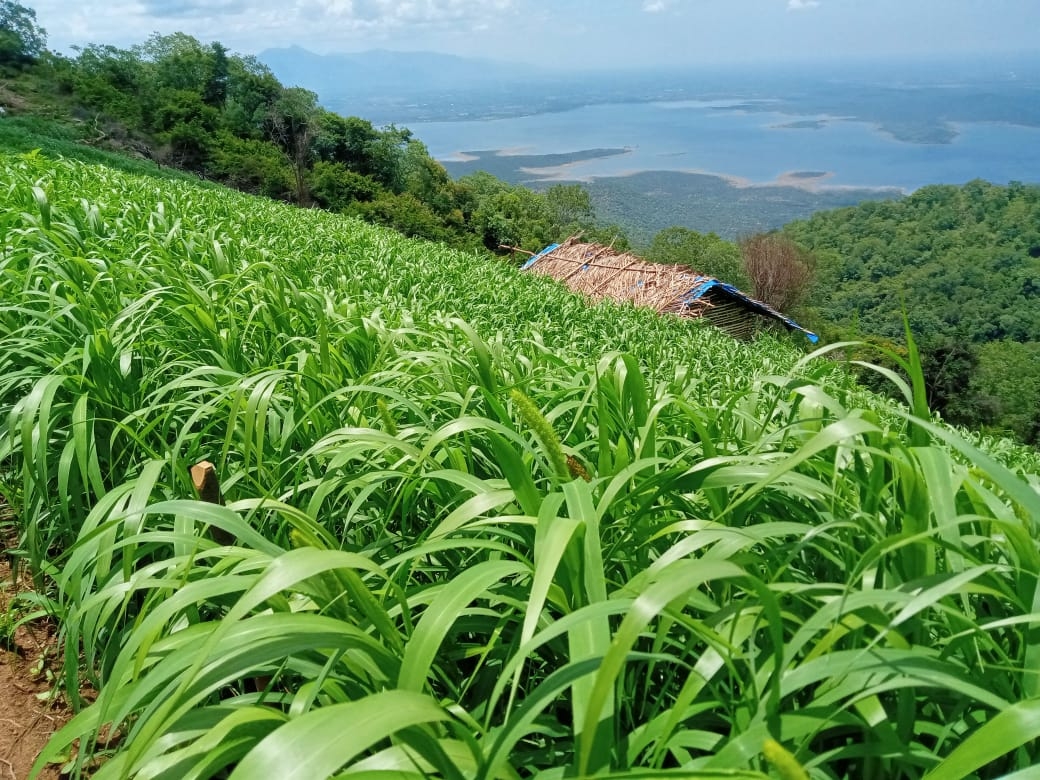
The Nilgiris district is home to several tribal communities, including the Irular, Kurumbar, Kota, Toda, Paniya, and Katunayakkar peoples, all classified as Particularly Vulnerable Tribal Groups (PVTGs). I belong to the southern part of the Nilgiris, where many villages are still located within or close to forests. Today, however, many people have moved closer to towns and roads because of education, employment, and changing livelihoods.
The villages inhabited by the Irula and Kurumbar communities are often located close to one another, and in some places, both communities live together.
I have heard elders say that tea and coffee cultivation became widespread only after British rule. Earlier, people gathered greens, tubers, and fruits from the forest while also cultivating grains and vegetables. Even today, though many people continue these practices, they also depend on wage labour and other forms of work.
The villages inhabited by the Irula and Kurumbar communities are often located close to one another, and in some places, both communities live together.
I have heard elders say that tea and coffee cultivation became widespread only after British rule. Earlier, people gathered greens, tubers, and fruits from the forest while also cultivating grains and vegetables. Even today, though many people continue these practices, they also depend on wage labour and other forms of work.

My great-grandfather’s house stood near the house where I lived when I was around twelve years old. It was a traditional house. I had seen houses like his before, but I had never noticed such fine workmanship. When my family renovated it, I had the opportunity to see for the first time the meticulous technology and knowledge that went into building it.
The base of the wall (kode) was made by stacking small stones and mixing them with soil. On top of that, bamboo was broken into small pieces (tappe(a) bol) and mixed with mud. The floor looked like a cement floor, but it was made entirely by spreading and levelling soil.
In that small house, my brothers and I listened to stories, riddles, and medicinal knowledge that my grandfather shared.
These houses are called Kadu Shale. They are constructed using bamboo and grass. The grain fields in hilly areas are mostly uneven rather than flat, so houses are built to allow people to monitor the entire farming area and the paths used by wild animals.
Inside the house, there would be a hearth for cooking and a few cooking utensils. A platform called Chappara is built in a specific area of the house from wood and bamboo, where harvested grains are stored. The floor is levelled with mud and plastered with cow dung. Flat stones used for grinding spices and coffee powder are kept at the edge of the house.
There is usually a small area in front of the house for lighting a fire. Irulas spent their nights in the light of this fire. They would roast and eat tubers and maize brought from nearby fields. When they were alone there, creating and learning to play traditional musical instruments such as Pugiri and Kowal was also part of daily life.
The base of the wall (kode) was made by stacking small stones and mixing them with soil. On top of that, bamboo was broken into small pieces (tappe(a) bol) and mixed with mud. The floor looked like a cement floor, but it was made entirely by spreading and levelling soil.
In that small house, my brothers and I listened to stories, riddles, and medicinal knowledge that my grandfather shared.
These houses are called Kadu Shale. They are constructed using bamboo and grass. The grain fields in hilly areas are mostly uneven rather than flat, so houses are built to allow people to monitor the entire farming area and the paths used by wild animals.
Inside the house, there would be a hearth for cooking and a few cooking utensils. A platform called Chappara is built in a specific area of the house from wood and bamboo, where harvested grains are stored. The floor is levelled with mud and plastered with cow dung. Flat stones used for grinding spices and coffee powder are kept at the edge of the house.
There is usually a small area in front of the house for lighting a fire. Irulas spent their nights in the light of this fire. They would roast and eat tubers and maize brought from nearby fields. When they were alone there, creating and learning to play traditional musical instruments such as Pugiri and Kowal was also part of daily life.
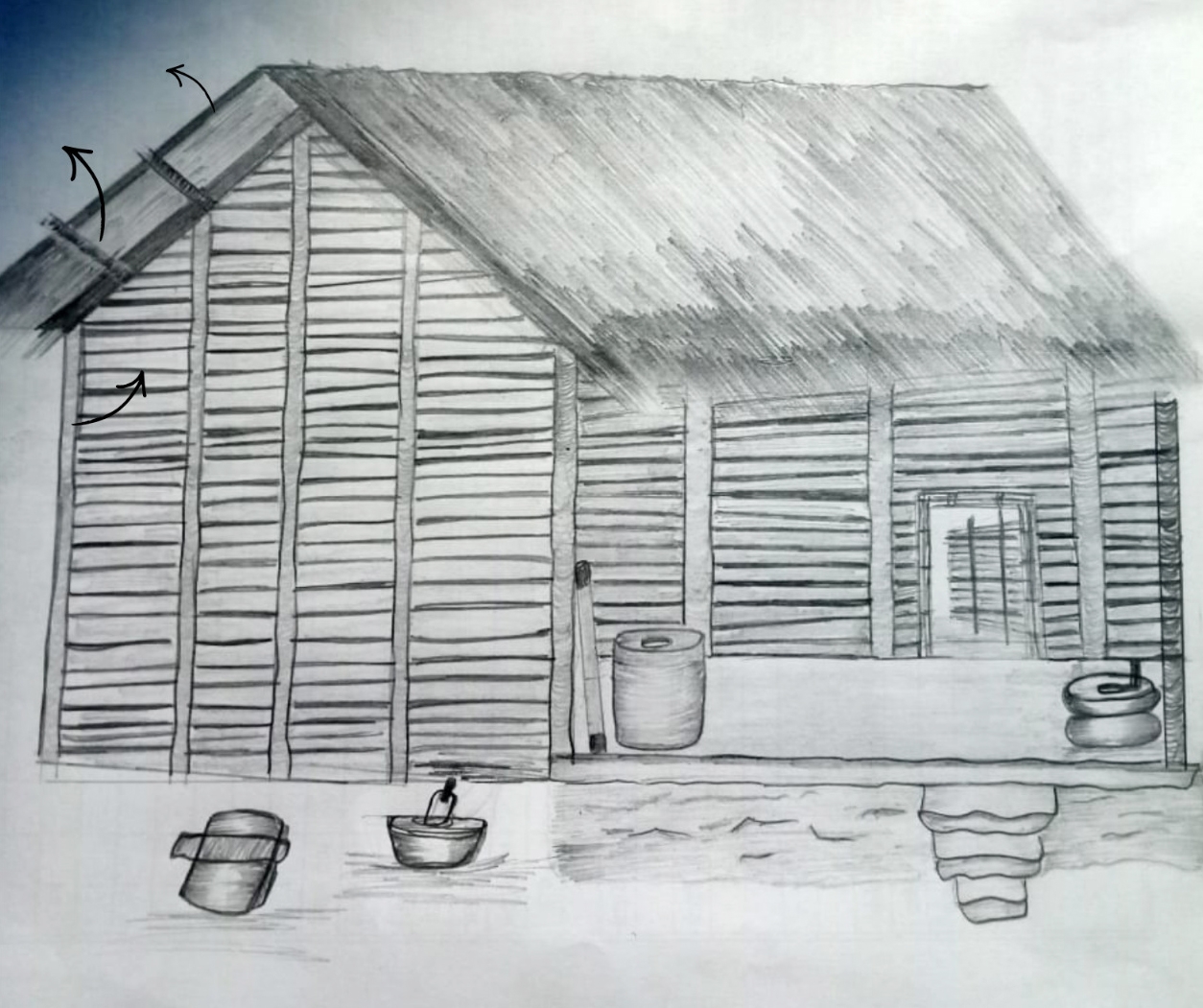
The exterior of a traditional Irula house, with its thinnai (verandah), alongside tools used in its upkeep. Illustration by Vinothini.
Between 2000 and 2005, my uncle’s parents practised grain farming in Manjeri, near Godagur village, about 35 kilometres from Kotagiri town. The slope of the hill meets the plains there.
They cultivated crops such as finger millet, little millet, foxtail millet, maize, spinach, pumpkin, mustard, different kinds of beans, and vegetables like chilli, onion, tomato, and brinjal. Leafy greens grew naturally around them. They only needed to buy oil, salt, and jaggery from shops.
Because of this, the house in that location was very important for sustaining a healthy way of life.
Even after permanent houses were built in other places, and even after the harvest season ended, some people continued to remain in those forest dwellings instead of returning to their homes.
The Irula people living in the Kotagiri region call their houses Kure. They divide the houses into three types:
They cultivated crops such as finger millet, little millet, foxtail millet, maize, spinach, pumpkin, mustard, different kinds of beans, and vegetables like chilli, onion, tomato, and brinjal. Leafy greens grew naturally around them. They only needed to buy oil, salt, and jaggery from shops.
Because of this, the house in that location was very important for sustaining a healthy way of life.
Even after permanent houses were built in other places, and even after the harvest season ended, some people continued to remain in those forest dwellings instead of returning to their homes.
The Irula people living in the Kotagiri region call their houses Kure. They divide the houses into three types:
- Kure
- Thoga Kure
- Shale
The house where people live in a settled area is called a Kure. The structure built for guarding traditional agricultural land is called a Kadu Shale, and the houses used for clan deities are called Thoga Kure.
The structures of Kure, Thoga Kure, and Shale differ slightly from one another. These houses remain warm during rainy and cold seasons, and cool during summer.
Earlier, the houses consisted of a single room with a verandah in front. Later, houses with two or more rooms were built. The base of the house was constructed using small stones. Trees were planted at the four corners of the house (Kavar). The wall is called Kode in the Irula language.
Permanent houses were built either entirely with small stones and mud or by tying small sticks or bamboo between wooden posts at intervals. Large bamboo pieces were then woven between them. A roof (Pari) was constructed using more bamboo or wooden supports and covered with Koyivaga grass (Pothesukathu).
The grass had to be layered carefully, with the base facing downward and the top facing upward. A vine called Kure Pihikka kodi was used to tie the structure together because it is long and does not break easily.
The Koyvaga grass used for roofing was also used after the death of a person living in the house.
The door (Padilu) was made by carving wood or using bamboo.
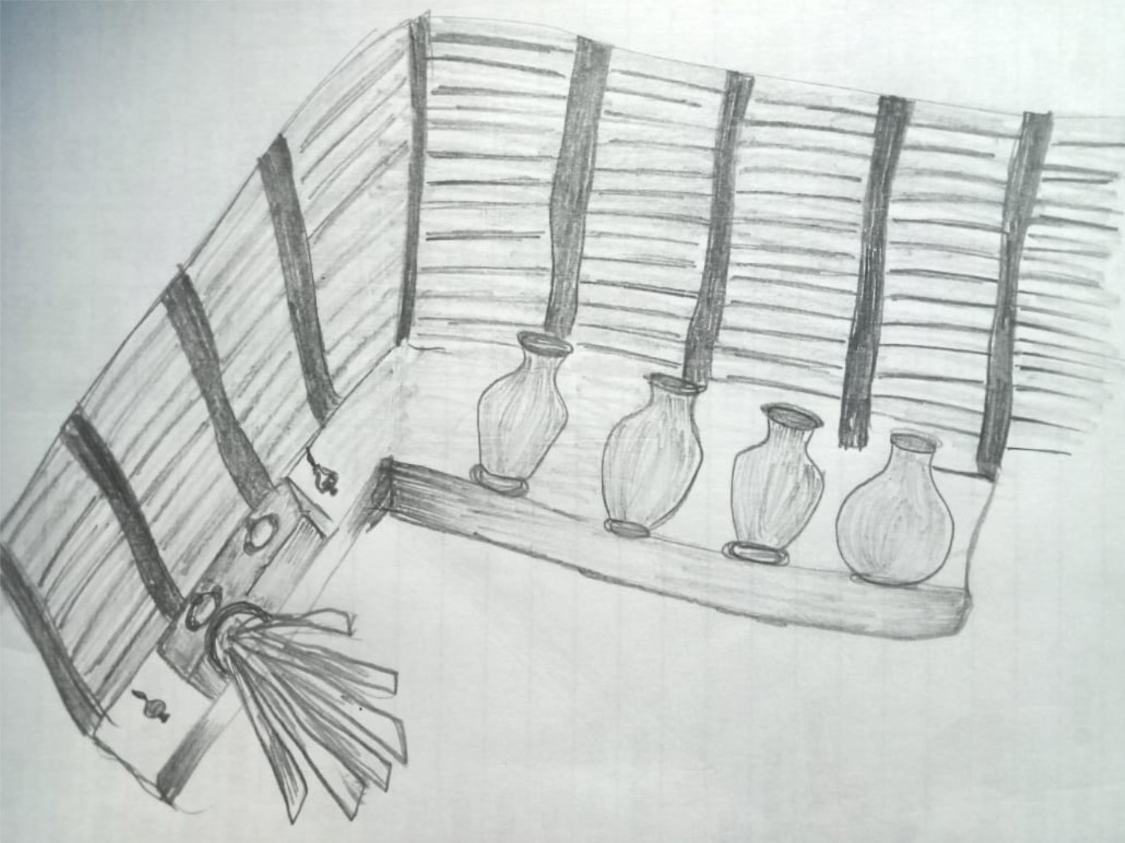
Inside of the kitchen. Illustration by Vinothini.
Traditional tribal houses had a close connection with nature, culture, and daily life. They were built using local materials such as mud, bamboo, wood, grass, and palm leaves. This kept the houses cool and environmentally friendly.
These houses were not merely shelters, but reflections of the community’s identity, beliefs, and relationship with nature.
Although the houses were not arranged in straight lines, they allowed easy interaction with neighbours. After completing household chores, people would light fires in front of their houses, and both adults and children would gather around them. Women continued their work while listening to conversations nearby. Knowledge about forests, folk tales, medicinal practices, and community systems was shared in these spaces.
These gatherings increased respect for the older generation. There was also enough space between the houses for younger people to observe and learn traditional cultural practices. In my community, people would play musical instruments in one place while men and women danced in circles around them. Elders and children would sit nearby watching and enjoying the dancing and music.
These houses were not merely shelters, but reflections of the community’s identity, beliefs, and relationship with nature.
Although the houses were not arranged in straight lines, they allowed easy interaction with neighbours. After completing household chores, people would light fires in front of their houses, and both adults and children would gather around them. Women continued their work while listening to conversations nearby. Knowledge about forests, folk tales, medicinal practices, and community systems was shared in these spaces.
These gatherings increased respect for the older generation. There was also enough space between the houses for younger people to observe and learn traditional cultural practices. In my community, people would play musical instruments in one place while men and women danced in circles around them. Elders and children would sit nearby watching and enjoying the dancing and music.

The construction of modern houses has affected many of these activities.
Traditional houses built with grass, bamboo, and mud could last for about 8 to 10 years. The smoke from the hearth hardened the bamboo, making it more durable. Some bamboo was also reused when houses were renovated.
Tribal people often took their children with them into the forest while collecting materials. Traditional methods of cutting bamboo, selecting grasses, preparing ropes, and building houses were not formally taught but passed down through observation. For this knowledge to continue, traditional methods of house-building must also continue.
As people began building houses with modern materials and technologies, knowledge of traditional houses gradually declined. Accessing forests has also become more difficult because of restrictions and the threat of wild animals. In many places, there are fewer elders who still possess this traditional knowledge, and along with them, even the oral histories connected to these houses may slowly disappear.
Since people live in forests and in areas adjacent to forests, they are caught between the inability to build modern houses and the inability to build traditional houses. They are forced to depend on others for survival and cannot live independently.
Traditional houses built with grass, bamboo, and mud could last for about 8 to 10 years. The smoke from the hearth hardened the bamboo, making it more durable. Some bamboo was also reused when houses were renovated.
Tribal people often took their children with them into the forest while collecting materials. Traditional methods of cutting bamboo, selecting grasses, preparing ropes, and building houses were not formally taught but passed down through observation. For this knowledge to continue, traditional methods of house-building must also continue.
As people began building houses with modern materials and technologies, knowledge of traditional houses gradually declined. Accessing forests has also become more difficult because of restrictions and the threat of wild animals. In many places, there are fewer elders who still possess this traditional knowledge, and along with them, even the oral histories connected to these houses may slowly disappear.
Since people live in forests and in areas adjacent to forests, they are caught between the inability to build modern houses and the inability to build traditional houses. They are forced to depend on others for survival and cannot live independently.

The house I lived in was not entirely traditional, but it still retained some of its features. I learned how to maintain that house neatly. Maintaining the house brought me peace of mind. When the floor was cleaned with cow dung, it acted as a natural disinfectant. I could also see how walking barefoot on the soil had beneficial effects.
Modern development has brought many changes to tribal houses. Concrete buildings, tiled roofs, electricity, roads, and government housing schemes have replaced many traditional homes. While these developments have improved safety, durability, and access to basic facilities, they have also led to the gradual loss of traditional knowledge, cultural practices, and environmentally sustainable construction methods.
As a result, traditional tribal houses are slowly disappearing. To preserve the heritage and identity of tribal communities, it is important to find ways to ensure that traditional building knowledge and cultural practices continue alongside modern needs.
Modern development has brought many changes to tribal houses. Concrete buildings, tiled roofs, electricity, roads, and government housing schemes have replaced many traditional homes. While these developments have improved safety, durability, and access to basic facilities, they have also led to the gradual loss of traditional knowledge, cultural practices, and environmentally sustainable construction methods.
As a result, traditional tribal houses are slowly disappearing. To preserve the heritage and identity of tribal communities, it is important to find ways to ensure that traditional building knowledge and cultural practices continue alongside modern needs.


You may also like
Read•Issue 10
The Many Homes of Streeties
BY Sindhoor Pangal, Ahana Rangachari, Surabhi Venkatesh, Juhi Patel, Sowjanya S
Read•Issue 10
Yangdol
BY Pankaj Singh
Read•Issue 10
Issue 10 | An Introduction
BY Ramya Reddy
Read•Issue 9
Chennai: Voices from a City
BY V.Sriram

Read•Issue 9
Service Before Self
BY General Rajan Ravindran

Read•Issue 9
A Sacred Drift Called Bhoomi
BY Latha Menon

Read•Issue 9
Etched in Stone: Rock art of Ladakh
BY Ahtushi Deshpande
Read•Issue 9
The House by the River
BY Parvathi Nayar