WORDS BYLatha Menon
As the car blurs out the distant hills and trees, my eyes begin focussing on the fields and farmers and their little pieces of land. They are digging and ploughing under the blistering sun, and I keep watching as they do so with great care. After all, this little piece of land is their past, present and future. Even at a time when farmers in India and around the world struggle with debt, drought, and fluctuations in demand and supply, a handful of Indian farmers continue to believe in their way of life. The old and new generations work together on their farms. They are incorporating new technology and science, while retaining respect and regard for their land and animals.

Pulipalayam
I am brought back from my musings by the gentle waft of Illayaraja’s tunes on the car radio. We have reached the first stop of our journey — the 10-acre farm of SV and K. Much of the farm is devoted to banana plantations, including both the Kerala variety and the smaller, yellow variety known as Kadali. Both these varieties are sold to the neighbouring state of Kerala. When SV and K commenced their cultivation, they were promised Rs 40 per kilo for the bananas. Relying on this, they invested close to Rs 150 per tree, but to their dismay, prices dropped to Rs 10 a kilo. SV attributes this to increased supplies from Karnataka, where many farmers have relocated, thanks to the improved availability of water. The farmers’ predicament is that when the bananas are ready to be plucked, they are unable to forecast the price and hence are resigned to an unpredictable yield-to-effort ratio.
They plan to plant turmeric in the adjacent acreage in the month of Chitrai – Panguni, which is mid-April in the English calendar. The turmeric harvest will be ready nine months later, exactly in time for the harvest festival of Pongal. In another acre, yam is cultivated, and close to that is a large ground where the cows are resting. SV, a class 9 dropout, took up farming after his father had an accident and was unable to do much physical work. His wife, who was 19 when they married, has also become a vital part of the extended family, while their four-year-old son attends school with his cousin, who is in grade 8. SV’s father, who can move around on his 25-year-old metallic blue Bullet motorcycle, is in charge of picking up and dropping off the boys. He also takes charge of bringing in the cattle feed and other tasks that require little physical strength.

SV tells me that three years ago, a crippling water shortage forced many farmers to abandon their fields. His family was able to manage after digging four borewells to a depth of 1,500 feet, but they are still in debt. SV enjoys farming, or “agri” as he calls it. His unmarried younger brother works in BSNL in Tiruppur. “Not farming?” I ask. “Why should all of us be in the same profession?” he responds.

This land, which belonged to SV’s grandfather, reveals itself in a gentle, unassuming way. As you turn off the main road into a narrow mud lane, you notice cows relaxing by the side. Beyond that is a path leading to a shed that sits under a beautiful pink flower canopy. The shed is flanked by two red-tiled single-storey buildings. One is home to a family of seven, and the other is a storeroom that houses all the farm equipment. Two dogs guard the buildings; both are named Tommy (or Dommy, as the old man insists on calling them). One is tied to a tree, while the other rests in a grilled, makeshift kennel beside it.
As you walk through their land, the open ground merges into a path that curves to the right and gradually rises upward. This narrow path, covered by trees, is the route I gently tread, led by SV and K. Banana plantations mostly line the path, with the occasional patch of fodder for the cows. K's favourite cow used to love jalebis, she tells me. It's a lot of hard work, and K says she is simply unable to put on weight. She laughs easily, and finds it hard to contain her smile. On our way back, I spot the guardian God tucked away on the right. This is a personal temple that belongs to the people who take care of the land. On Mondays and Fridays, and on full-moon days, they light a lamp to the god.
As you walk through their land, the open ground merges into a path that curves to the right and gradually rises upward. This narrow path, covered by trees, is the route I gently tread, led by SV and K. Banana plantations mostly line the path, with the occasional patch of fodder for the cows. K's favourite cow used to love jalebis, she tells me. It's a lot of hard work, and K says she is simply unable to put on weight. She laughs easily, and finds it hard to contain her smile. On our way back, I spot the guardian God tucked away on the right. This is a personal temple that belongs to the people who take care of the land. On Mondays and Fridays, and on full-moon days, they light a lamp to the god.

I return to the house and strike up a conversation with K’s mother-in-law. "K came knowing nothing, but picked it up as she became one among the family," the mother-in-law tells me. "It is very helpful to have an extra pair of hands and a companion.” She then reminisces, "My father made this house pucca. It must have been over 30 years ago, after my marriage to SV's father. I came from Ooty, and this became my home." As a woman, you are privy to the heartbreaks of women. When K is called away, the mother-in-law gently whispers to me that K lost a child just two months ago. It is a moment of two women sharing the pain of another woman's loss. It is a moment of quiet.
When K returns, the banter continues. Her sister is married to a man who works in a company, and her brother works in a mobile shop. Both siblings are younger. She's hardly travelled much -- just to visit her parents, or areas nearby. She complains about the increased peacock menace; at least 20-40 peacocks walk through their 10 acres every day, whereas five years ago, one could see only a few. “Of course, there are snakes, but we both keep our distance,” she says with a laugh. “Do you have children?” she asks. “Two girls,” I replied. “Oh, that's expensive,” she responds. I smile and don’t get mad at her, understanding where she’s coming from. Instead, I explain that I gave them a good education so that they would create new thoughts and ways. I also add that I would not pay any dowry! She gets the drift and smiles back at me.
We left at 10:30 am and drove on State Highway 174 towards Madurai on our way to Theni. It has taken us about 5 ½ hours, and we stop for lunch at a place where the staff is a bit taken aback when we ask for simple thali meals. They try to sell us special meals, including fried paneer and fried gobi (cauliflower) manchurian. When we refuse all those, he offers a special mushroom fry. We reject it all. What about juice? Negative again. They stand by the table as we eat, hoping we’d change our minds!
We drive away, heading to a village that is flanked by windmills.
Sirapparai
Ra and R live in a stunning vista that runs along the highway. You set your eyes on it the moment you touch the Vaigai Dam close to Kumaramangalam: these imposing mountains, their layers running parallel, offer a breathtaking view. We drive through slowly, asking for directions to the village. The hills are watching us, perhaps wondering if we could understand the topography of this landscape. We turn right and climb up into a busy village. The road is lined with two-storey concrete homes, painted in vivid colours--traditional vaastu colours. People watch us as our driver struggles to manoeuvre the car through- school children walking back home, young girls balancing pots of water, little children running out of their homes on either side of the narrow road. I admire the driver’s dextrous skill in not knocking them over, given that they run with gay abandon! Women sit on the steps of their homes; girls walk home from school in groups, and boys do too, with a spring in their stride. We are part of the rural choreography.

We cross the narrow path with difficulty; the school buses here expect you to give them the right of way. Houses also vie for space on the road; it appears that they landed with a thud on the ground and haphazardly occupied their space. Curious eyes watch us as they realise we are not locals. We finally come to a junction where, if we go right, we would lose sight of the mountains, and if we go straight, there is no large dairy farm in sight. We’ve been given directions, and a farmer passing by confirms that we need to turn left. R is waiting expectantly on the road, clad in a white shirt and a checked lungi. It is about 4:15 pm, and I have time until sunset to understand the farmers and their land, as well as how they manage their agricultural practices.
This is a 35-acre farmland, 25 of which his grandfather owned and the rest later acquired by his father. They once grew vegetables such as tomatoes, beans and brinjal. It's been close to 10 years since rain has blessed this land, so the farmers have had to innovate. They know how to cultivate their land with foliage that requires as little water as possible. So, vegetables have been replaced with fodder for the cows, and drumstick trees have been planted. Their earlier batch grew terribly, and now they are working on the next installment, hoping that it will fetch a good yield and a good price.

R tells me that fodder has reduced due to the increased heat and disappearing water in their 950 ft deep borewell. The path to the dairy farm is surrounded by cotton trees; the cotton, once it ripens, belongs to his sister. The loss of rain for ten years has taught them how to use water. "There was a time when it rained, the mountains would have rivulets of water trickling down the way, and when you stood on our land, it would appear like streams of water racing down the mountains to the land," he says with a tinge of nostalgia. If there were water, the farmers would all be millionaires with cars, he tells me. But this is not to be. So they find other ways.
R used to keep a few cows, but it’s only in the last two years that he’s been focusing on the dairy farm. A farm that helps raise their three daughters. The older daughters are in the 12th and 10th grades, respectively, and live in the hostel. Their youngest is in grade 4. The couple works together, sharing responsibilities and balancing home and farm harmoniously. Their youngest daughter helps them on the farm whenever she is free.
Ra is nostalgic and tells me about a cow that was bountiful in its yield, which they unfortunately lost to a snake bite. Her mother had prophesied that the cow would give them a higher return. Soon after, the cow was bitten. Ra still carries that ache in her heart. "It was dark, as we didn't have electricity then," she whispers. "Now we have solar power,” she adds with a touch of confidence. No snake or anything can come close as she keeps a hawk's eye on each of the cows.
Will their daughters want to run the farm? They take their time to answer. "Can't say. They help and support me whenever they come." They receive approximately 80 litres of milk daily and hope to increase this yield. Ra and R are dreamers – the dairy farm, which they began only two years ago, has enhanced their life and is fulfilling many of their dreams. Their three daughters are excelling in their studies, and they hope the children can dream of becoming whatever they aspire to be. The land, when it rains, and water becomes plentiful, will surely make them wealthy. For now, they are practical and hardworking.
We drive back quickly from Sirapparai through Vaigai Dam Road, on NH 7/41, thanks to our fast and furious driver, to reach our next destination. We had begun close to the river Vaigai near Andipatti and drove via the Varusanadu hill range and the majestic Western Ghats that line this area. The setting sun played with its luminosity, first sharp and straight into our eyes, then moving above the mountain ranges, and later slowly sinking behind them. It is 6.15 pm, and the light is dimming. The sky has lost its source. Yet, as the car keeps going, a pink hue bleeds onto the sky, and the 'sunset sky' becomes a visual canvas for nearly 20 minutes. It's a blissful orange moment.

Nanapetti
As I enter V and J's farm, set behind their home, I see that they have a large shed to house about ten cows. Working in the shed is a woman wearing a bandana-like headgear; her sari is hiked up to her ankles, and a man’s shirt is worn over that to protect her modesty and help her work efficiently. With her is a girl wearing Indian salwar pants, and similarly clad in a shirt. They are cleaning the shed, taking water from the pipe, and removing the cow dung, guiding it to the centre of the shed, where a sunken channel carries the wet dung to the fields. This is the manure for fields where the fodder for the cows is cultivated.
The cows make way for them each time the lady approaches, lifting their hooves and moving their bodies as the water from the hose touches them. I discover that she is J, the Lady of the house, and the young girl is her daughter, who is on a week's break from college. She is a first-year B.Sc. Maths student. J and her daughter are vigorously working in the shed, barely glancing at us as we walk in. They are expecting us, but they continue to work. Things can't be left unfinished in farming.
I keep watching them; the daughter being guided by her mother in a gentle, yet firm way. The mother isn’t perturbed about people observing them at work. The conversation is limited to just the two of them. The early morning light streams through the gap in the roof of the shed, casting a divine glow upon J as she goes about cleaning the shed. She truly lives the adage “Work is Worship”. Their sincerity is mesmerizing, and I wait patiently till they are done.
While they change out of their work clothes, I stay and review their farm and cows. The layout is easily accessible. The house welcomes you at the front, occupying a tiny portion of their 9-acre land. The lane that runs along the side of the house goes past a patch of bare red earth where the hay is stored. The cows are tied to posts in front of the haystack. There is another lane perpendicular to the first, and stacked here are the feeding cement basins used for their morning feed. The cattle shed is situated behind the house, and when viewed from the road, it appears to be the larger building. It’s easy to see what gets priority here!

The shed is large, housing about eight cows on each side and can accommodate more if necessary. It has an asbestos exterior, with the interior ceiling and facade made from indigenous straw woven into a checked pattern, which enables cooler temperatures during the summer. A goat shed occupies the adjacent space. The rest of the land is used for cultivating fodder for the cows. There’s corn and green feed that occupies squares of land, taking up most of the nine-acre plot. J tells me they have two 900-foot borewells. Lack of rain has forced the change from agriculture to dairy farming which has taken a toll on many farmers. They need a regular income to sustain their family and livelihood, while agriculture has remained largely neglected, ignored and cast away. The grief is palpable, but they refuse to dwell on it.
J is a cheerful lady content to live her husband's dream. "Whatever he likes, whatever he plans, we all help him make it happen," she says. Like K, she came here after her marriage, and farming became her way of life. She has a twinkle in her eyes when she talks about her cows. There is a large black cow which towers over the others on the farm. "Her name is Bullet," J says with a smile. When I ask her why, pat comes the reply. "Because she moves so fast." The Bullet bike from Royal Enfield's stable is well-known in most villages of Tamil Nadu. J enjoys her work more when her daughters come home during their hostel break and help her out at the farm. Her daughters are pursuing their B.Sc. in mathematics, in the 3rd year and 1st year, respectively, and are as supportive of their father's vision as their mother.
His younger daughter says that her father decides to sell cows only at night because that's when the daughters are sleeping and can't stop him. He knows the children are attached to their cows, and their tears will make it harder for him to sell the animals. She speaks with an ache in her heart, but accepts that it’s her father's profession and his economic decision. So, like other things in life, she learns to live with that pain.

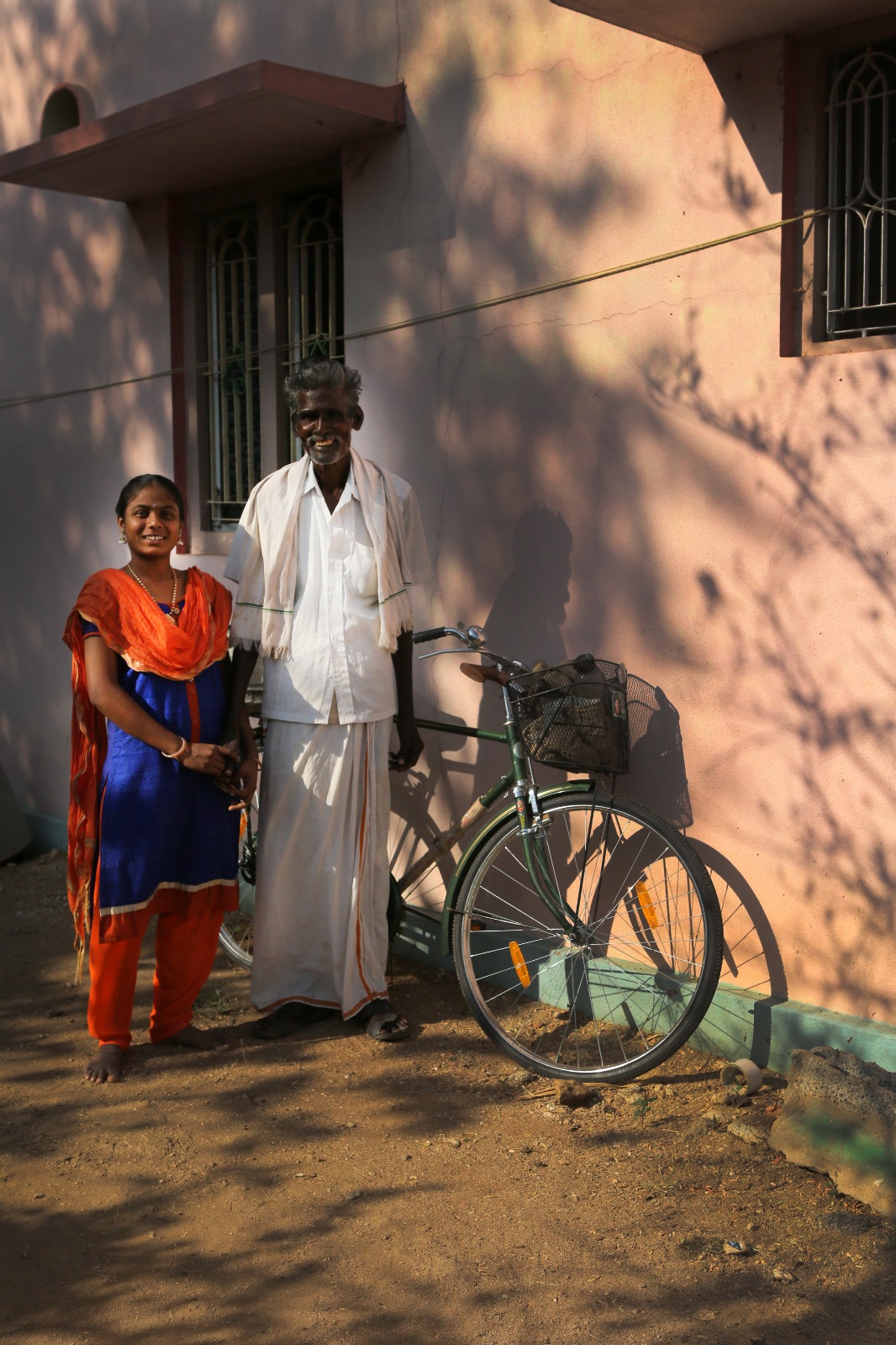
V is a man who has weathered many disappointments, yet he has a classic “never say die” attitude. He had once tried his hand at dairy farming over a decade ago and suffered losses. However, when his children encouraged him to try again, he found the courage to reinvest, and his farm is now thriving. One remembers Tolstoy's quote from Anna Karenina: “'All happy families are alike; each unhappy family is unhappy in its way.” V has a vision for his children as well, guiding them to take subjects which will give them the flexibility to pursue other things in future. Their youngest and only son, who's in 11th grade, will inherit this farm, which he intends to keep. He is already invested in it and works as hard as his sisters, perhaps harder, as he is the only one living 24/7 with his parents at the moment.
Besides, he is proud of what his parents do, unlike many children of agricultural families who pursue professional courses and feel that being a farmer is “uncool”'. They would rather sell the 'land' that nurtured them to some real estate dealer or let it go to waste by ignoring the stories that were born from the soil, brushing off the sweat of their ancestors and failing to understand the intrinsic value of the “land.” They will realize much later in their lives when the “land” outlives them. “It is their responsibility to hand over that 'Bhoomi' (earth) they have inherited, to the next generation to tend to and in turn pass it on to their children, thus continuing the cycle,” said a wise old farmer.
I think of the little piece of land that held me in its thrall. That was in a small town called Alwaye (now Aluva), situated on the banks of the River Periyar. It is a beautiful river, the heartbeat of Aluva, and the second-largest in the state. Aluva was also my father's hometown. My father, after becoming a railway officer, was posted in many different places in India. It was in the summer that we would all return to Aluva. The land I remember is the land where he grew up. A 22-cent piece of land that my grandfather bought grew many fruit-bearing trees, built a small well, and a little house to raise his children. Both my grandparents were teachers, and although they retired by the time I was born, they never stopped teaching life's lessons to all their grandchildren.
My grandfather began his mornings early.
My earliest memories of him are of a man who was disciplined and followed a routine. He was not a farmer but had all the makings of one. And I would tail him in everything he did, as he was my first and dearest friend. The land had a jackfruit tree, a cashew nut tree, and a small banana plantation, in addition to guava and mango trees. My grandfather maintained them all, with me serving as his assistant (not that he needed one) during my vacations. I watched with awe as he shaped, pruned, cut, and watered all the trees. He did this every day till he passed on, and then we cremated him near the banana plantations on his little piece of land. Years later, when the land was sold by one of the family members who inherited it, I spent many a desolate moment, wishing I could have kept that land alive the way he did.



You may also like
Read•Issue 10
The Many Homes of Streeties
BY Sindhoor Pangal, Ahana Rangachari, Surabhi Venkatesh, Juhi Patel, Sowjanya S
Read•Issue 10
The Shape of an Irula Home
BY Jeyanthi R
Read•Issue 10
Yangdol
BY Pankaj Singh
Read•Issue 10
Issue 10 | An Introduction
BY Ramya Reddy
Read•Issue 9
Chennai: Voices from a City
BY V.Sriram
Read•Issue 9
Service Before Self
BY General Rajan Ravindran

Read•Issue 9
Etched in Stone: Rock art of Ladakh
BY Ahtushi Deshpande
Read•Issue 9
The House by the River
BY Parvathi Nayar